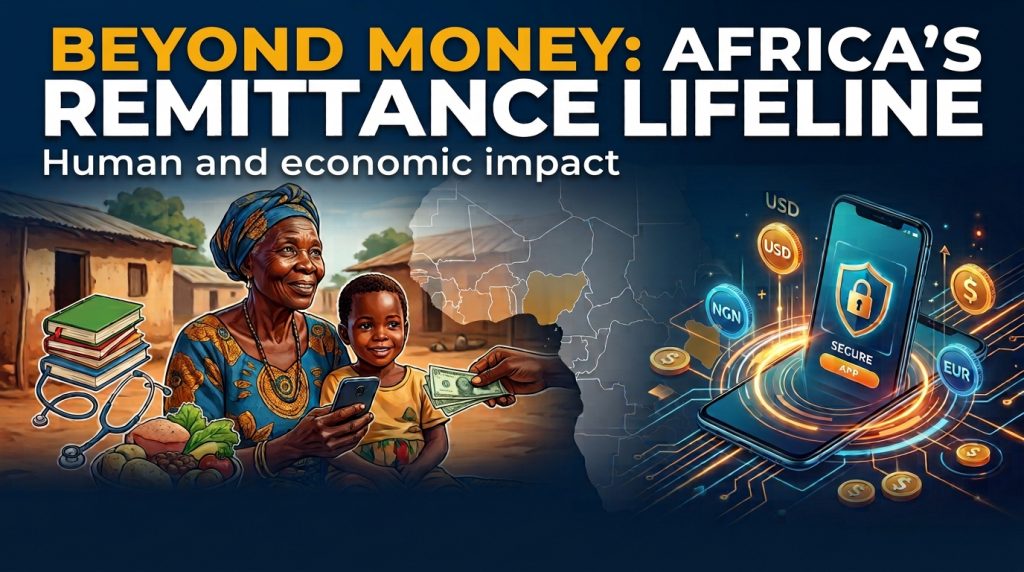
Beyond Money: Africa's Remittance Lifeline - The Human and Economic Impact
Join our live webnar with Simona Schreier
Remittances are one of the most important financial connections between migrants and their home countries. For millions of families across Africa, money sent from abroad helps cover everyday needs, education, healthcare and housing. They influence families and communities, move through increasingly complex financial systems, and have the potential to contribute to investment and long-term economic development.
At the same time, high transaction costs, informal transfer channels, currency instability, inequality and brain drain raise important questions about their wider impact.
Our speaker is:
Simona Schreier, Project Manager at the Munich Forum for Dialogue, where she coordinates international initiatives on migration cooperation, dialogue and sustainable development. She also contributes to the field as a PhD researcher, bringing together academic research and practical experience in migration, reintegration and transnational development.
People, families & communities – How remittances shape household decisions, social relationships, inequality and communities, including the role of social remittances.
The changing financial landscape – How formal and informal channels, FinTech, digital finance, transaction costs and regulation are changing the way money moves across borders.
Economic impact & investment – Whether remittances can move beyond everyday consumption to support businesses, jobs, investment and long-term economic opportunities.
Policy, diaspora & the remittance paradox – How governments and financial institutions can strengthen the development potential of remittances while addressing challenges such as brain drain.
Our three-part podcast series Remittances and Development introduces many of the questions we will explore further during the live discussion.
Listen to the episodes, then join us for the webinar to ask questions, share your perspective and continue the conversation.
Diese Website verwendet Cookies, um Ihre Erfahrungen zu verbessern. Wir gehen davon aus, dass dies für Sie in Ordnung ist, aber Sie können die Verwendung von Cookies ablehnen, wenn Sie dies wünschen. Cookie EinstellungenZustimmen
Cookies Policy
Privacy Overview
This website uses cookies to improve your experience while you navigate through the website. Out of these, the cookies that are categorized as necessary are stored on your browser as they are essential for the working of basic functionalities of the website. We also use third-party cookies that help us analyze and understand how you use this website. These cookies will be stored in your browser only with your consent. You also have the option to opt-out of these cookies. But opting out of some of these cookies may affect your browsing experience.
Notwendige Cookies sind für die ordnungsgemäße Funktion der Website unbedingt erforderlich. Diese Kategorie enthält nur Cookies, die grundlegende Funktionen und Sicherheitsmerkmale der Website gewährleisten. Diese Cookies speichern keine persönlichen Informationen.